In today’s 24/7 world of TikTok, Instagram, Twitter, blockbuster movie marketing, radio and TV ads, YouTube and influencers, it’s increasingly challenging for brands to cut through the, as one industry expert put it, ‘growing ad clutter’. This leads to reduced impact and increased resistance from consumers.
So, how do you get your brand to stand out? One way is by aligning a brand message with the right soundtrack. It’s vitally important to select the appropriate tracks to enhance your brand identity and create a strong emotional connection. We’ll look at music’s impact on brand perception, and give you practical guidance, tips, and best practices for choosing music for your brand.
The Science of Soundtracks – Why Music Is Important
In the early 1990s, The Association for Consumer Research conducted a study on the impact of music in ads on TV. They found that it improved effectiveness in ways including:
- Higher purchase intent
- Improved attitude towards the brand and the ad itself
- Enhanced consumer persuasion and ad recall
- Increased preference for the advertised product
- Improved mental image memory of the product
All of these elements are key when it comes to brand-building.

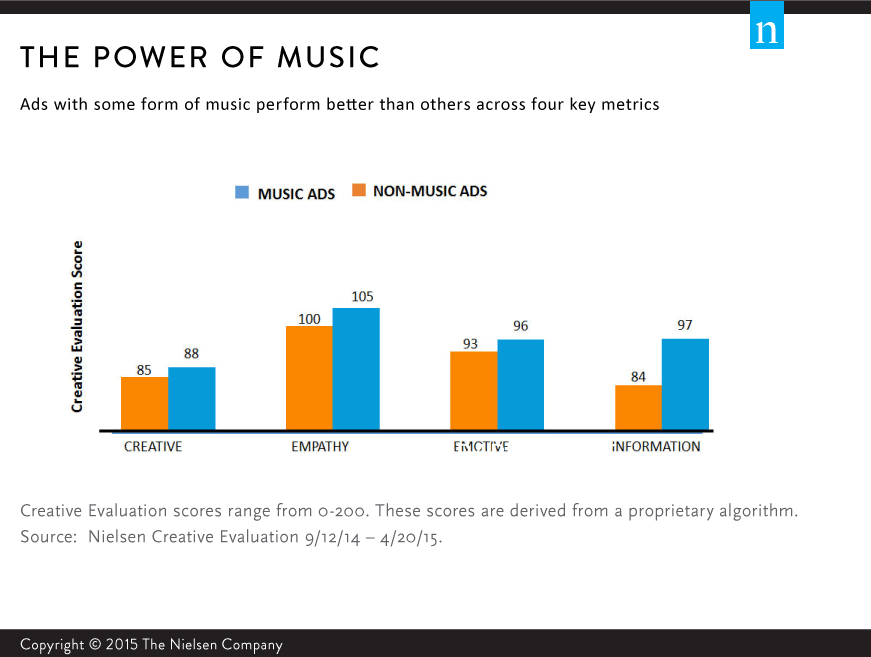
Photo Credit: www.nielsen.com
Neuroscientists have analysed the brain mechanisms related to memory, finding that words set to music are the easiest to remember. This is because music memory is stored in a few different parts of the brain.
Given the fact that on average, it takes eight touchpoints with your brand for a prospect to become a lead with online advertising, the ability of music to increase ad recall, mood enhancement and the likelihood of purchasing makes it a vital element.
But what music should you choose to represent your brand and create a memorable brand experience? First, you need to establish some key elements: brand identity and values, and your core customer and what drives them.
Need a hand? Audio Network are experts in creating music made for sync and soundtrack selection for branding including LEGO, Netflix and Nike.
Understanding Your Brand Identity & Values
How do you define and understand your brand’s identity and values? These are the first things you need to get right when you’re creating a brand – they form a guiding light for your journey.
Your brand values are a core set of beliefs that your business holds closest to its heart and define both your employee experience and your customer’s.
Examples of brand values could include:
- Integrity – making ethical, transparent and well-intentioned decisions
- Innovation – prioritising new, progressive ideas
- Honesty – being upfront with information
- Trust – nurturing positive relationships
Whatever you decide your core values are, be specific – corporate jargon is confusing – and address both internal and external goals. Think about what sets your organisation apart from others, and concentrate on bringing those aspects to light to attract the right customers and employees.
Google, for example, has ‘ten things we know to be true’ as their set of corporate values:
- Focus on the user and all else will follow
- It’s best to do one thing really, really well
- Fast is better than slow
- Democracy on the web works
- You don’t need to be at your desk to need an answer
- You can make money without doing evil
- There’s always more information out there
- The need for information crosses all borders
- You can be serious without a suit
- Great just isn’t good enough
Nike is one of the world’s biggest brands, valued at over $50 billion – the most valuable sports brand in the business, according to Interbrand.
Its core values revolve around:
- Groundbreaking innovation
- Sustainability
- Social impact
- Diversity
With a mission statement, ‘to bring inspiration and innovation to every athlete in the world’, this ethos, ‘is what drives us to do everything possible to expand human potential. We do that by creating groundbreaking sport innovations, by making our products more sustainably, by building a creative and diverse global team and by making a positive impact in communities where we live and work.’
Find out how Nike has used music to create brand alignment in their ads through the decades.
Brand Personality & Target Audience
Once you’ve nailed down your values, it’s crucial to have a clear understanding of the brand’s personality, target audience, and desired emotional response. Who are your ideal customers? What’s their demographic?
If you have a core age group in mind – for example Gen Z, Millennials, Gen X, etc., then there is a wealth of information and statistics available as to how they behave, where they find their information from, what influences them when buying products or services – from online influencers to reviews and peer recommendations – and what defines their preferences, behaviours and motivations. Once you have this information to hand – and bear in mind that platforms such as TikTok can emerge and change the face of a demographic’s behaviour and engagement almost overnight – you can start to put the brand pieces together.
Establishing your brand’s core values and personality will also help with everything from your ‘brand bible’ (i.e. the set of brand guidelines) – bringing in visuals, such as logos and colour palettes and fonts – and the language you use, from your tagline to your website, social media and advertising.
How you communicate these defining attributes and emotions through visual, verbal and sensory cues – including music – will all reinforce your core message and mood.
People accompany their lives with different soundtracks – either intentionally or unintentionally, from their Spotify lists to their favourite movies. Certain songs become ingrained in our experiences, contributing to the memories we develop, either positive or negative.
In terms of music branding tips, if you’ve got a fun, energetic, youth-oriented brand, go for upbeat music that reflects what’s topping the streaming charts – whether that’s pop (still the most popular worldwide), reggaeton or hip hop/R&B, which dominates the US market. Tap into what your audience is listening to right now, as Valentino did with their ‘Rendez Vous’ promo, starring Zendaya, with a soundtrack of ‘Crystalised’ by The xx:

However, if your brand is more sophisticated or premium, you might opt for orchestral, jazz or ambient music. Brands which want to inspire a feeling of trust in their customers – such as banking or financial services – often use classical music; the fact it’s been popular for centuries makes it both familiar and gives it an enduring feel. Even if there are financial ups and downs, this music suggests that your bank, pension or insurance provider will see you through – they endure as the music has.
Crafting Emotional Connections Through Music
As everyone knows from movie and TV soundtracks, music has the power to evoke emotions and create connections with the audience. From blockbuster superhero trailer music to generate awe and excitement, to action thrillers with pumping drums and guitar riffs full of drive, sci-fi with the kind of out-of-this-world sounds that Hans Zimmer specialises in and quirky comedies, music can both guide and enhance a viewer’s emotion.
Fast-paced tracks take you to the edge of your seat; slower pieces with plenty of piano or melodic strings are more relaxing or romantic.
So, what emotional responses do you want your core audience to experience? Tailor your tempo, instrumentation and genre accordingly.
For example, look at how a brand like IKEA uses different types of music, according to the emotions it wants you to feel, in their Wonderful Everyday ads.
The cinematic soundtrack for ‘The Troll’, for example, moves from an uneasy, ominous feel for the set up (we’re supposed to find the Troll living under the bridge threatening), to a much lighter, increasingly magical theme, with bright woodwind as the small boy helps him to make his dingy dwelling a home by adding IKEA pieces:
Their Christmas ad, ‘Silence the Critics’, used rap diss track ‘Fresh ‘n’ Clean (Silence the Critics)’ by D Double E for a blend of comedy and threat, reflecting the family’s anxieties about hosting in their flat – solved through getting some IKEA items to freshen up its look.
Christmas ads are the most obvious master-manipulators when it comes to using music to create an emotional response – you only need to think of John Lewis’ wistful, slowed-down covers of iconic hits to feel a bit misty-eyed. The visual storytelling is brilliant, but it’s the combination of that and their brand messaging through music that’s created a viral sensation nearly every year. And the media has latched onto the idea that the launch of the brand’s festive campaign heralds the start of Christmas – not to mention that the featured tracks are also huge download successes.
Christmas 2022’s ad didn’t even really sell you any John Lewis products – ‘The Beginner’ used ‘All the Small Things’ to underline the fact that the ad was basically about empathy, with a man trying to learn to skateboard so that he’d have a way to connect with his foster-daughter.
These two contrasting examples show that you don’t have to use classic Christmas music to tell your story. Meaning that you don’t necessarily need to go the obvious route when it comes to telling your brand story through music, either.
Enhancing Brand Storytelling - Selecting the Right Music for Your Brand
For a greater understanding of the hold that successful brands have over us, watch this fascinating explainer on how Apple and Nike have crafted their individual images and stories:

Given how important it’s proven that music is, in terms of brand recall and creating emotion, it’s obviously not enough to randomly choose any old royalty-free background music for brand storytelling.
If you’ve got the budget, you could commission an original song, as Oreo did with ‘Wonderfilled’. Performed by Owl City, the anthem stars classic baddies such as the Big Bad Wolf and a vampire:

The catchy song is upbeat and quirky – matched with cute animations, it kick-started a whole series of ads, positioning the brand as a fun treat that could… potentially change the world?!
Subsequent spots featured freestyle rapper Chiddybang and singer/songwriter Kacey Musgraves, with lyrics and animation styles changing with each execution. Touching on themes from heartbreak to high school life, this is how to expertly use a track to cement brand identity and recognition.
Choosing the Perfect Brand Soundtrack
Of course, when it comes to music and brand identity, there’s always the ‘sonic logo’ – such as McDonald’s ‘I’m Lovin’ It’ signature, or Intel’s three-second, five-note sound logo, which it’s estimated is played somewhere in the world every five minutes.
Just a few seconds long, if done right, the sonic logo is strong enough to stand in place of the brand’s name and helps to literally cut through the noise being made by everyone else.
However, Uli Reese from sonic branding agency Amp advises that putting all your eggs in that particular basket is a risk: ‘The anatomy of our brains is not wired to understand sound and noise. It’s wired to recall music – we’re born Mozarts.’
Why not compare and contrast what competitor brands are doing with music, to see how you could choose the music to fit your brand?
For starters, take a look at Uber Eats. Their ‘Do Less’ ads are both quirky and retro, with a 60s/70s feel and each soundtrack matches the ‘hero character’:

Ordering takeaway food is something that everyone does nearly daily now; so how do Uber Eats stand out? They’ve positioned themselves with stories and music that are out of the ordinary, and a bit left-field. There’s no particular emphasis on what kind of food you can order, just on the brand message of, ‘embrace the art of doing less.’ If you’re an Uber Eats customer, the subliminal messaging is telling you you’re an individual, you’re stylish, you don’t follow the herd.
This Deliveroo ad has a similar set up, with a guy dancing, but it’s in an empty space, and the emphasis is on how excited he is that his food has arrived, as it starts with the doorbell, rather than finishing with it.
Just Eat went with the Oreo approach of a unique song for their Katy Perry ad – and created a whole world to go with it. It used their ‘Did somebody say Just Eat?’ jingle, and the song showcased all the different cuisines and drinks you can score from the home delivery service.
The lyrics reinforce the brand’s key message – that you can get anything you want to eat or drink at any time delivered right to your door – and the mood is upbeat but chilled, quirky and fun.
Or, sticking with the food theme, you can use music to drive your whole story. In one of 2023’s best ads, ‘Raise Your Arches’, McDonald’s used Yello’s classic 80s track ‘Oh Yeah’, directed by Edgar Wright of Baby Driver and Shaun of the Dead fame. The mass lunchtime office exodus is expertly choreographed to the track, as are its beat-matched raised eyebrows.
This track drives the narrative – when you’re choosing a track for your brand, do you want to foreground the music, or have something that’s more of a background element?
If you want a retro or a nostalgic feel, then work out which decade you’re aiming for, and choose accordingly; you might want a well-known track for instant recognition, or something a bit more obscure for a less mainstream brand.
Navigating Copyright & Licensing Considerations
When you’re looking for unique music for your brand, you need to keep copyright considerations front of mind. It’s easy to fall foul of licensing on platforms such as YouTube (which can take down your channel if you’re found to be flouting the rules.)
Here’s a quick explainer on the basics of copyright music:
- The copyright holder of a music piece – often called the ‘author’ – is the person who created the song. Usually, this is a composer or a lyricist
- The author possesses the right to ensure others are not reproducing, distributing, utilising, performing or playing the song in public without their permission
- Regardless of the genre, the author automatically gains copyright protection when they create a musical composition
- A musical piece is protected under copyright law for the author’s entire lifetime, plus 70 years. After this, the music becomes part of the public domain
If you’re hoping to use a piece of music that’s protected by copyright for your brand, you must first obtain a licence from those who wrote and recorded the song. More often than not, you can find the contact information for these individuals on ASCAP, SESAC and/or BMI.
Licensing popular tracks can be expensive, so if your brand doesn’t have a big budget for music, then look to a reputable music licensing platform like Audio Network. Thousands of original, high-quality tracks are at your fingertips, with all the licensing pre-cleared for global use.
Making the whole process far more straightforward, you can license either a single track or get a tailored subscription if you’re looking for several tracks to form an audio ‘brand suite’. There’s a huge range of search functions, together with hand-picked themed playlists covering every mood and genre, making life even easier.
Using pre-cleared music ensures that you’re adhering to all compliance rules and avoiding any potential legal issues. Find out more about licensing by reading our FAQs.
How to Align Your Brand Message With the Right Soundtrack
As you can see, when you’re creating a cohesive brand experience with music, you need to focus on: soundtrack alignment with brand values; music selection for effective storytelling; and maximizing brand impact through music integration.
Bringing together your message with the right soundtrack can be transformative. Audio Network’s original, high-quality music is a trusted source by brands worldwide when they’re looking for that perfect track. Explore hundreds of thousands of tracks to get you started.
Need Music for Your Project?
At Audio Network we create original music, of the highest quality, for broadcasters, brands, creators, agencies and music fans everywhere. Through clear and simple licensing, we can offer you a huge variety of the best quality music across every conceivable mood and genre. Find out how we can connect you with the perfect collaborator today by clicking the button below!
This page was updated 28/05/2024 and 27/06/2024.